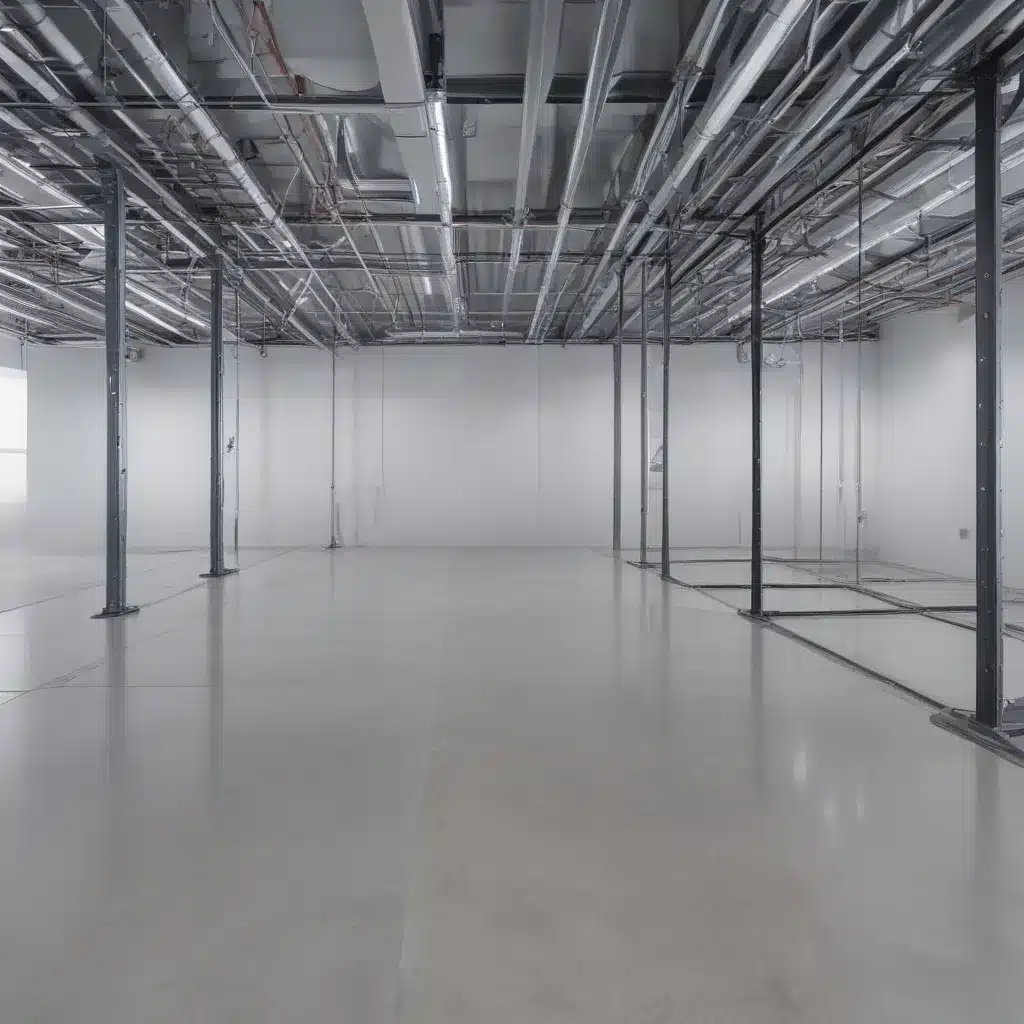
As an experienced raised flooring consultant, I’ve seen firsthand the critical role that effective cooling plays in the performance and longevity of commercial and office environments equipped with access flooring systems. In today’s data-driven world, the ability to accurately model and optimize the thermal behavior of these raised floor installations is more important than ever. That’s why I’m excited to explore the fascinating intersection of machine learning and raised floor cooling strategies.
Raised Access Flooring: An Overview
Before delving into the specifics of predictive cooling models, let’s quickly review the key structural and functional characteristics of raised access flooring systems. These innovative floor solutions, commonly found in modern office spaces, data centers, and other commercial settings, offer a range of benefits that make them an increasingly popular choice.
Structural Characteristics
Load Capacity: Raised access floors are designed to support heavy loads, including the weight of equipment, furniture, and foot traffic. Careful selection of panel materials and pedestal configurations ensures that these floors can withstand the demands of a busy commercial space.
Pedestal Adjustment: The height-adjustable pedestals that support the floor panels allow for precise leveling and accommodating uneven subfloors, ensuring a smooth, uniform surface.
Dimensional Tolerances: Strict manufacturing standards and installation protocols maintain tight dimensional tolerances, enabling a clean, seamless appearance and efficient integration of building services.
Thermal Performance
Airflow Management: The void space between the subfloor and the raised access floor, known as the plenum, plays a crucial role in the thermal performance of the system. Careful planning of airflow patterns and vent placement can optimize cooling efficiency.
Raised Floor Plenum: This hidden cavity beneath the floor serves as a conduit for the distribution of cooled air, allowing for targeted and efficient cooling throughout the space.
Thermal Modeling: Advanced computational fluid dynamics (CFD) techniques can be employed to model the complex airflow and heat transfer dynamics within the raised floor plenum, informing design decisions and optimization strategies.
Cable Management
Cable Trays: Recessed cable trays integrated into the raised floor system provide a convenient and organized way to route power, data, and telecommunication cables, facilitating easy access and maintenance.
Underfloor Service Distribution: The raised floor plenum can be leveraged to distribute critical building services, such as HVAC, electrical, and IT infrastructure, in a clean and accessible manner.
Accessibility and Maintenance: The modular nature of raised access floors allows for quick and easy access to the underfloor space, simplifying maintenance and modifications as needed.
Regulatory Compliance
Building Codes: Raised access flooring systems must comply with local building codes and regulations, ensuring the safety and structural integrity of the installation.
Fire Safety Standards: Stringent fire safety requirements, such as those outlined in the relevant British Standards (e.g., BS EN 12825), guide the selection of materials and design features to mitigate fire risks.
Environmental Sustainability: Sustainable design considerations, including energy efficiency, material selection, and recycling potential, are increasingly important factors in the specification and installation of raised access flooring.
Cooling Strategies for Raised Access Flooring
With a solid understanding of the key characteristics of raised access flooring systems, let’s delve into the exciting realm of applying machine learning to predict and optimize their cooling performance.
Computational Fluid Dynamics
Computational fluid dynamics (CFD) has emerged as a powerful tool for modeling the airflow and heat transfer dynamics within the raised floor plenum. By simulating the complex interactions between air, heat sources, and the physical structure of the system, CFD analysis can provide valuable insights into the thermal behavior of the space.
However, traditional CFD modeling can be time-consuming and resource-intensive, particularly when evaluating multiple design scenarios or responding to changes in the environment. This is where machine learning can step in to enhance the efficiency and accuracy of these thermal analyses.
Predictive Modeling
Machine learning algorithms can be trained on vast datasets of CFD simulations, historical performance data, and real-world measurements to develop predictive models of raised floor cooling performance. These models can then be used to quickly and accurately forecast the thermal behavior of the system under various conditions, such as changes in heat load, airflow patterns, or environmental factors.
For example, a machine learning model might be trained on CFD simulations of different raised floor configurations, panel types, and air distribution strategies. By feeding the model with parameters like floor dimensions, pedestal height, and vent placement, it can then output predicted cooling performance metrics, such as air temperature, velocity, and pressure distribution within the plenum.
Optimization Techniques
Building on the predictive capabilities of machine learning, optimization algorithms can be employed to identify the most effective cooling strategies for a given raised access flooring installation. This could involve exploring a range of design scenarios, evaluating trade-offs between competing performance objectives (e.g., energy efficiency, temperature uniformity, airflow distribution), and automating the selection of optimal system configurations.
By coupling machine learning models with optimization techniques, raised flooring consultants can provide clients with data-driven recommendations that maximize the thermal efficiency and overall performance of the access flooring system. This, in turn, can lead to significant energy savings, improved occupant comfort, and reduced maintenance requirements over the lifetime of the installation.
Sensor Integration and Performance Analytics
The integration of environmental sensors and real-time performance monitoring systems can further enhance the capabilities of machine learning-based cooling models for raised access flooring.
Environmental Monitoring
Strategically placed sensors within the raised floor plenum can continuously collect data on key environmental parameters, such as temperature, humidity, air velocity, and pressure. This data can be fed into the machine learning models, allowing them to adapt and refine their predictions based on the actual conditions in the space.
Performance Analytics
By analyzing the sensor data and correlating it with the machine learning model’s predictions, facility managers and building operators can gain valuable insights into the system’s real-world performance. This information can be used to identify optimization opportunities, troubleshoot any issues, and fine-tune the cooling strategies over time.
Automated Controls
The integration of machine learning-powered predictive models with automated building management systems can take the optimization of raised floor cooling to the next level. By continuously monitoring environmental conditions and adjusting airflow, temperature setpoints, and other parameters in response to the model’s recommendations, these intelligent control systems can optimize energy consumption, maintain optimal occupant comfort, and proactively address any potential cooling-related problems.
Retrofitting and Upgrades
While the benefits of machine learning-enhanced raised floor cooling are compelling for new installations, there is also significant potential in applying these techniques to existing systems and legacy infrastructures.
Legacy Systems
Many commercial and office buildings currently operate with older, less efficient raised access flooring systems. By employing machine learning-based analyses and optimization strategies, facility managers can identify opportunities to upgrade and retrofit these legacy systems, improving their thermal performance and energy efficiency without the need for a complete overhaul.
Modular Expansions
As businesses grow and evolve, the ability to seamlessly expand and reconfigure raised access flooring systems is crucial. Machine learning models can be leveraged to evaluate the impact of such changes on the cooling performance, ensuring that any modular expansions or reconfigurations maintain the desired level of thermal efficiency and occupant comfort.
Energy Efficiency Measures
Beyond the core cooling optimization, machine learning can also support the implementation of broader energy efficiency measures for raised access flooring systems. This could include optimizing airflow management, evaluating the impact of alternative panel materials, or assessing the feasibility of integrating renewable energy sources or thermal energy storage systems into the overall building infrastructure.
Future Trends and Innovations
As the commercial and office landscape continues to evolve, the role of machine learning in raised floor cooling is poised to become increasingly vital. Here are a few emerging trends and innovations to keep an eye on:
Intelligent Building Systems
The integration of machine learning-powered predictive models with advanced building management systems will likely become the norm, transforming raised access flooring installations into highly responsive, self-optimizing components of the broader intelligent building ecosystem.
Thermal Energy Storage
The integration of thermal energy storage solutions, such as phase-change materials or underground thermal energy storage systems, can further enhance the efficiency and resilience of raised floor cooling strategies, leveraging machine learning to optimize the charging and discharging cycles.
Renewable Energy Integration
As the push for sustainability and carbon neutrality gains momentum, the incorporation of renewable energy sources, such as solar or geothermal systems, into raised access flooring cooling strategies will become increasingly important. Machine learning can play a crucial role in optimizing the integration and operation of these renewable energy systems.
Conclusion
In the fast-paced world of commercial and office environments, the ability to accurately predict and optimize the cooling performance of raised access flooring systems is a game-changer. By harnessing the power of machine learning, raised flooring consultants can provide their clients with data-driven solutions that maximize energy efficiency, maintain optimal occupant comfort, and ensure the long-term viability of these critical building infrastructure components.
As we continue to push the boundaries of what’s possible in the realm of raised access flooring and building automation, the integration of machine learning will undoubtedly play a pivotal role in shaping the future of sustainable, intelligent, and responsive commercial spaces. Stay tuned for more exciting developments at the intersection of raised flooring and cutting-edge predictive technologies.
If you’re interested in learning more about how machine learning can enhance the performance of your raised access flooring system, be sure to visit raised-flooring.co.uk for the latest insights and expert guidance.

