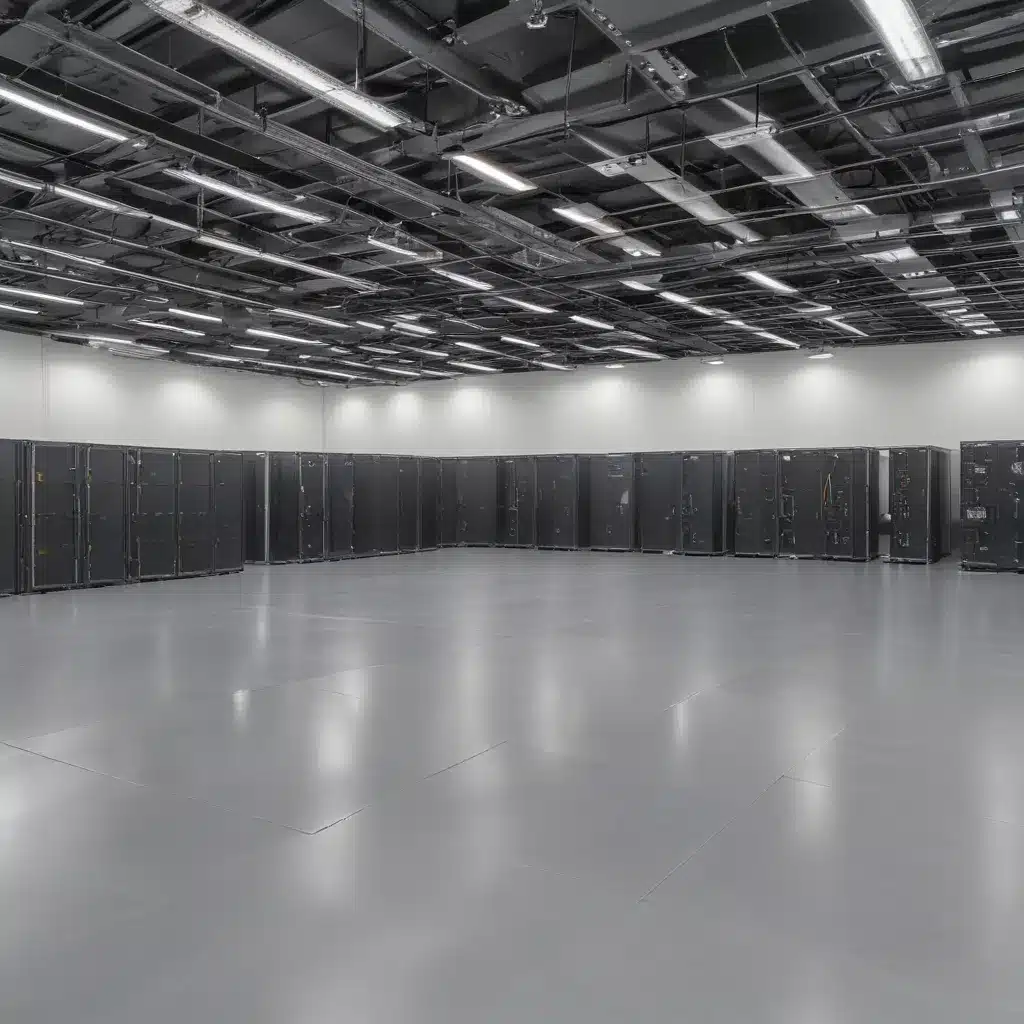
As an experienced raised flooring consultant, I’ve had the privilege of working with data centre operators across the UK to design, install, and maintain cutting-edge access flooring systems that address the evolving cooling challenges faced by today’s power-hungry computing environments. In this comprehensive guide, I’ll explore the latest innovations in raised flooring technology and share insights on how these solutions can significantly boost the energy efficiency of data centre cooling systems.
Raised Access Flooring Fundamentals
At the heart of any modern data centre lies a robust raised access flooring system, which serves as the foundation for the entire facility’s infrastructure. These modular flooring platforms provide a critical pathway for essential services, including power, data, and cooling distribution.
Flooring System Overview
Raised access floors are typically composed of steel-encapsulated panels supported by an array of adjustable pedestals. This design allows for easy access to the hidden subfloor space, enabling flexible routing of cables and seamless integration with cooling systems. The panels themselves can be fabricated from a range of materials, such as high-density particleboard, steel, or even concrete, each offering unique advantages in terms of load-bearing capacity, durability, and thermal conductivity.
Structural Integrity
One of the key considerations in data centre raised flooring is the ability to withstand the immense weight of servers, storage arrays, and cooling equipment. Load-bearing capacity is a critical specification, with modern data centres often requiring panels capable of supporting 1000 kg/m² or more. Robust pedestal designs, along with precision installation techniques, ensure the structural integrity of the flooring system, even under the most demanding conditions.
Accessibility and Maintenance
The inherent accessibility of raised access floors is a significant advantage in data centre environments. By providing a dedicated subfloor space, operators can easily route, modify, and maintain power, data, and cooling infrastructure without disrupting mission-critical operations. Additionally, the ability to quickly remove and replace individual panels simplifies tasks such as cable management, equipment upgrades, and targeted maintenance.
Cooling Optimization
One of the primary drivers for the adoption of advanced raised flooring solutions in data centres is the need for enhanced cooling efficiency. As computing densities continue to increase, the ability to effectively manage airflow and heat dissipation becomes paramount.
Temperature Regulation
The subfloor cavity created by raised access floors serves as a dedicated pathway for cold air distribution. By strategically positioning supply air vents and perforated floor panels, data centre operators can ensure a consistent, targeted supply of cooling air directly to the IT equipment. This precision cooling approach helps mitigate the formation of hot spots and uneven temperature gradients across the facility.
Airflow Management
Alongside temperature regulation, efficient airflow management is critical for maximizing the cooling capacity of a data centre. Raised access floors facilitate the implementation of contained hot and cold aisles, directing the flow of cool air through the IT equipment and capturing the heated exhaust for recirculation or expulsion. This aisle containment strategy, combined with advanced computational fluid dynamics (CFD) analysis, allows for the optimization of airflow patterns and the elimination of wasteful air circulation.
Energy Efficiency
The ability of raised access flooring to enhance cooling efficiency directly translates to significant energy savings. By reducing the overall cooling load and minimizing the energy consumption of fans and compressors, data centre operators can achieve remarkable improvements in power usage effectiveness (PUE). In fact, modern raised flooring systems, when combined with other cooling innovations, can help drive PUE values below 1.05, representing a reduction in cooling-related energy consumption of up to 90% compared to traditional air-cooling approaches.
Raised Flooring Design
As data centre cooling demands continue to evolve, the design of raised access flooring systems has also matured to meet the increasing requirements for high-density, energy-efficient cooling.
Load Capacity Considerations
The growing appetite for high-performance computing and artificial intelligence workloads has driven the need for higher density server configurations, often exceeding 100 kW per rack. Raised access flooring systems must be designed to accommodate these elevated load-bearing demands, with panel and pedestal specifications carefully engineered to provide the necessary structural support.
Pedestal Adjustment Mechanisms
In data centres where flexibility and scalability are paramount, the ability to fine-tune the floor height is a crucial design element. Advanced pedestal adjustment mechanisms, capable of up to 600 mm of vertical adjustment, enable seamless integration with evolving cooling infrastructures and allow for the easy deployment of new IT equipment.
Cable Management Strategies
Effective cable management is essential for maintaining the efficiency and reliability of data centre operations. Raised access floors provide ample space for the organised routing of power, data, and cooling distribution networks. By incorporating strategically placed cable cutouts, cable trays, and cable ladders, data centre designers can ensure a clutter-free, easily navigable subfloor environment.
Regulatory Compliance
As with any mission-critical infrastructure, data centres must adhere to a range of performance standards, safety regulations, and sustainability guidelines when it comes to raised access flooring systems.
Performance Standards
In the UK, the BSEN 12825 standard serves as the primary reference for the design, testing, and evaluation of raised access flooring. This comprehensive framework covers load-bearing capacities, safety factors, and dimensional tolerances, ensuring that data centre flooring systems meet the rigorous requirements for reliable operation.
Safety Requirements
Beyond structural integrity, data centre raised flooring must also comply with fire safety and electrical safety regulations. This includes careful selection of floor panel materials that meet stringent flammability and smoke emission criteria, as well as the robust grounding and bonding of all conductive components to mitigate electrical hazards.
Sustainability Guidelines
With the growing emphasis on environmental sustainability in the data centre industry, raised access flooring solutions must also demonstrate energy efficiency and resource conservation. Innovations such as recycled content, low-emission manufacturing, and end-of-life recyclability are becoming increasingly important in the selection and specification of raised flooring systems.
Conclusion
As the demand for higher computing power and greater energy efficiency continues to drive the evolution of data centres, raised access flooring systems have emerged as a critical enabler of these transformations. By leveraging the latest innovations in structural design, airflow management, and regulatory compliance, data centre operators can unlock substantial cooling efficiency gains and positioning their facilities for long-term success.
To learn more about how Raised Flooring UK can help you optimise your data centre’s cooling performance, visit our website at http://raised-flooring.co.uk/. Our team of experienced consultants is ready to guide you through the selection, installation, and maintenance of the most advanced raised access flooring solutions tailored to your unique requirements.

